Crime & Law
12-Person Jury Selected for Michael Madigan's Landmark Corruption Trial
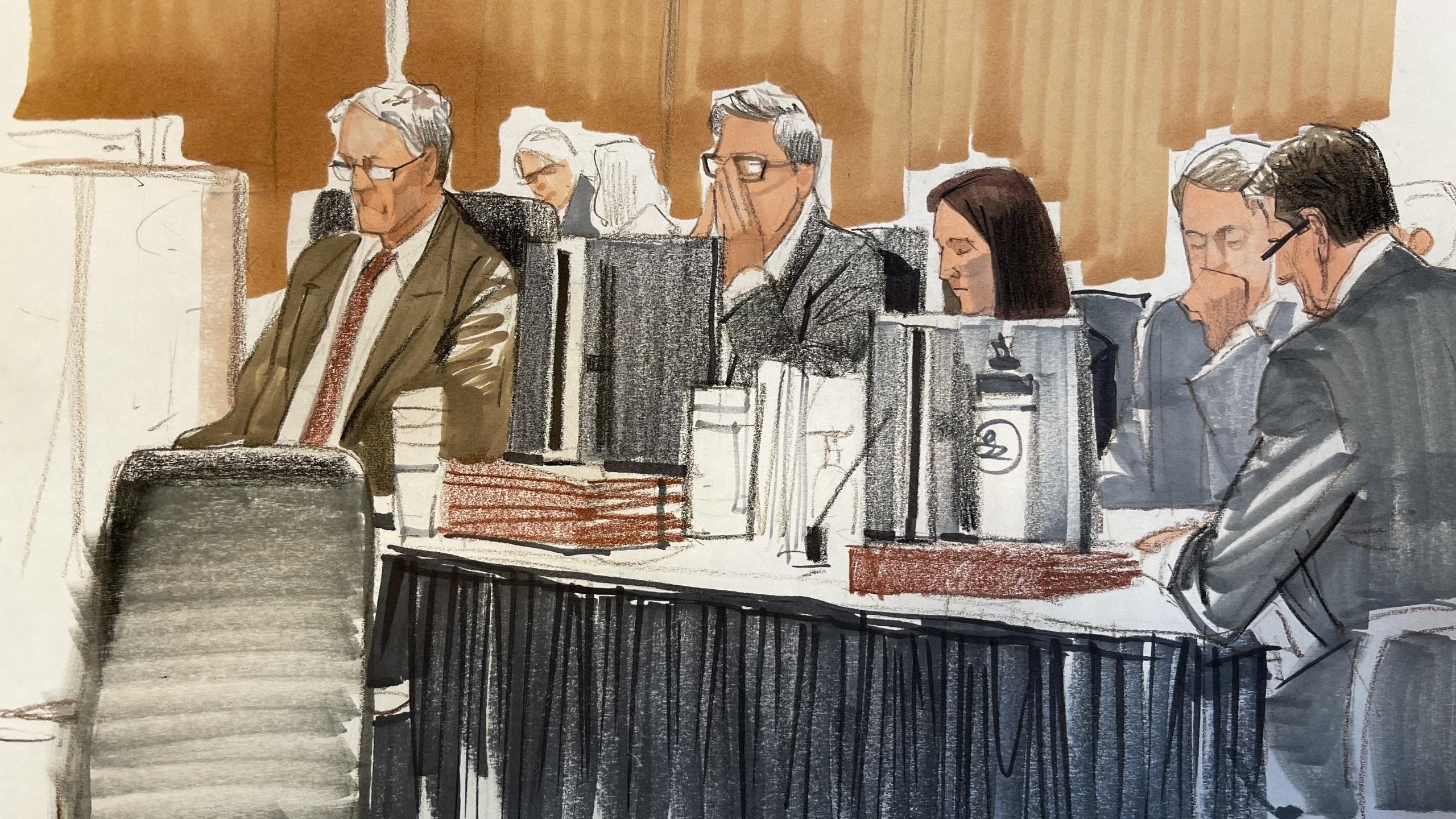 A courtroom sketch depicting ex-Illinois House Speaker Michael Madigan, left, alongside his attorneys inside the Dirksen Federal Building during jury selection in his corruption case. (Cheryl Cook)
After a week of questioning, a dozen people have been seated as jurors in ex-House Speaker Michael Madigan’s landmark corruption trial, but opening statements are not expected until next week as jury selection remains ongoing.
One additional juror was seated Thursday after none were selected following full days of questioning Tuesday and Wednesday at the Dirksen Federal Building, where Madigan and his longtime confidant Michael McClain stand accused of racketeering, bribery and wire fraud.
That brings the total number of jurors to 12 — enough for a full jury. One alternate was also seated Thursday morning, and by the end of the day, three more had been chosen. But with no proceedings Friday, the final two alternate jurors will have to be selected Monday morning. Opening statements could be held later that day depending on how long questioning takes.
The 12th juror selected Thursday was a man who works at Community First Medical Center in Chicago. He said he would like to leave the state, citing crime and high real estate taxes.
When asked about his thoughts on Madigan, he said he recognized the name but didn’t know what political positions he’s held. He described his thoughts on the former House speaker as “fairly neutral.”
The process for selecting a jury is laborious. Individual jurors are separated into groups of 18 and are then face one-by-one questioning from Judge John Blakey, prosecutors and defense attorneys for both Madigan and McClain.
That can take anywhere from a few minutes to nearly an hour per person as the parties are asked about an array of topics — their media consumption, where they live, any political ties and their thoughts on politicians who serve for life.
After getting through each group, Blakey and the attorneys settle any for-cause challenges — which weed out potential jurors that one side or another believe couldn't hear the case fairly or have some type of hardship that would prevent them from serving for a nearly three month trial.
Parties on each side are then able to use peremptory challenges, which allow them to strike potential jurors without giving a reason.
Anyone who makes it through all the challenges without being excused is added to the jury.
The first 18-member panel questioned this week — a process that took all of Tuesday and much of Wednesday — resulted in no new jurors as every single person was struck for one reason or another.
The trial is expected to last at least 11 weeks.
But Blakey on Thursday asked prosecutors and defense attorneys to conduct a more granular analysis of their witness questioning to try and get a more exact timeline estimate for the trial.
Following the slow pace of jury selection, Blakey has repeatedly mentioned the possibility of a “shot clock” to keep things moving. He said Thursday he may still consider instituting one for the entire trial as well, though he noted it would be a “long” clock that wouldn’t interfere with either side's opportunity to complete their questioning.
“It’s not my desire to do that,” he said, “but If I have to do that I will do that.”
The former House speaker is alleged to have orchestrated multiple corruption schemes, wielding his substantial political power to reward loyal allies and enrich himself.
Among the allegations included in Madigan’s 23-count indictment are claims he arranged contract jobs for his associates — who did little actual work — with Commonwealth Edison and AT&T Illinois, and in exchange he offered political backing on Springfield legislation that was favorable to those companies.
Both Madigan and McClain have denied any wrongdoing. McClain was previously convicted along with three other ComEd officials for conspiring to bribe Madigan, but those defendants have not yet been sentenced and have sought to have those verdicts tossed out.